Ethiopia's year-on-year general inflation rate climbed to 15.3% in July 2018 EFY, up from 13.7% recorded in the same month of the previous year, according to the latest report from the Ethiopian Statistical Service. The month-on-month general inflation rate also saw an increase, rising by 2.6% compared to the previous month. For more comprehensive economic updates, visit our Data Intelligence portal.
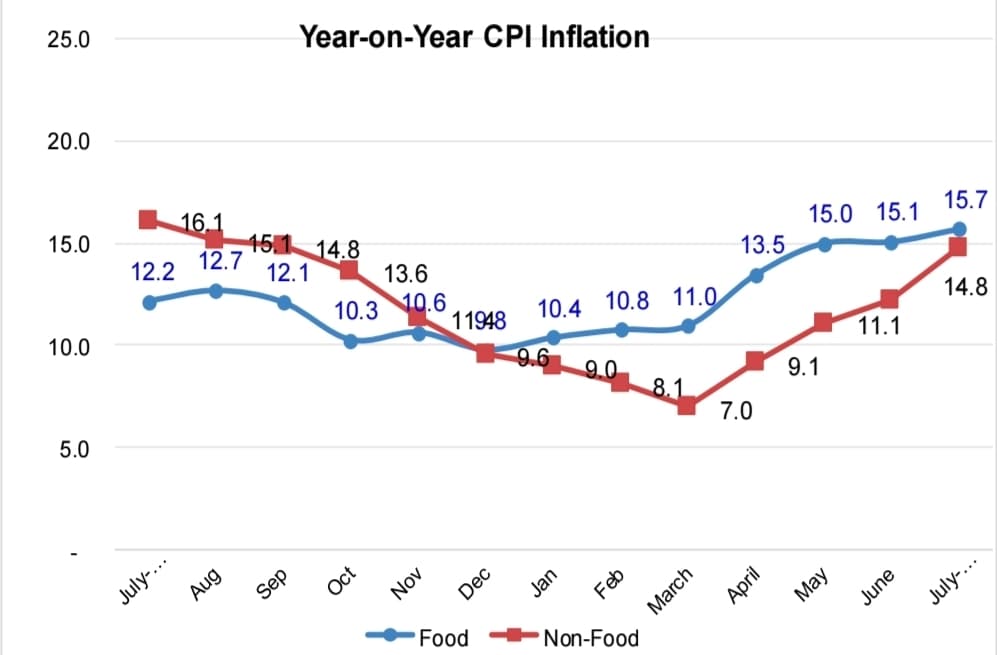
The report highlights that the food and non-alcoholic beverages component, which accounts for a significant share of the consumer price index, experienced a year-on-year inflation rate of 15.7%. Major contributors to this rise included significant price hikes in sugar, honey, and chocolate (39.4%), non-alcoholic beverages (33.0%), meat (21.6%), and oils and fats (20.3%).
Non-food inflation also contributed to the overall trend, registering an annual increase of 14.8%. Key drivers within the non-food sector included rising costs for education (25.3%), miscellaneous goods and services (19.3%), and alcoholic beverages and tobacco (16.0%).
The following table summarizes the year-on-year inflation components for July 2018 EFY:
| CPI Items |
Weight in CPI (%) |
% Change Year-on-Year |
| Major Food and Non-Alcoholic Beverage |
53.5 |
15.7 |
| Major Non-Food Components |
46.5 |
14.8 |
| Meat |
4.1 |
21.6 |
| Non-Alcoholic Beverage |
5.1 |
33.0 |
| Housing, Water, Electricity, Gas & Fuel |
16.8 |
13.3 |
The Ethiopian Statistical Service noted that while annual inflation remains in double digits, the 12-month moving average inflation rate was reported at 11.9% for July 2018 EFY. The agency also announced plans to modernize its data collection by incorporating 80 new markets into its survey methodology, bringing the total to 200 markets starting in July 2025. This move aims to better capture the economic realities of newly emerged regional states and reflect current demographic shifts.
The report attributed the relative easing of non-food inflation in recent periods to the implementation of tighter monetary policies aimed at managing bank credit. Investors looking to analyze the impact of these trends on the bank sector or compare performance across various financial institutions can find detailed metrics on Aksion. Historically, the country has faced significant inflationary pressure, particularly during EFY 2014 and 2015, when rates exceeded 30% due to a combination of internal conflicts and global economic challenges. Stay updated with the latest business and market news to navigate these economic shifts.



 ABAYB1300
 AWAB2364.29
 BOAX1705.71
 GDAB1004.71
 SIDAX1300
 TELE422.19
 WGBX1137.5